Grades 3 to 10 - at-home practice, honest results
See exactly where your child is strong, where they struggle, and what to work on next.
Point of Progress is an at-home practice version of the adaptive assessments schools use two to three times a year. One purchase covers both math and reading & writing. It adapts as your child answers, measures and reports performance at skill level, and transforms that into a fully individualised workbook built from their own results.
“Your school gives you a map. We give you a compass.”
How it works
Take the test
Your child answers on screen, at home, at their own pace. It adapts as they go, so it finds their real level in about five questions instead of marching them through forty at the wrong one.
Get the report
A score on a stable scale, how it compares with typical for the age, and the named skills that need work - question by question, with the likely thinking behind each wrong answer.
Open your workbook
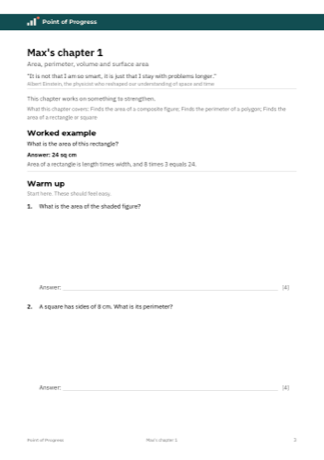
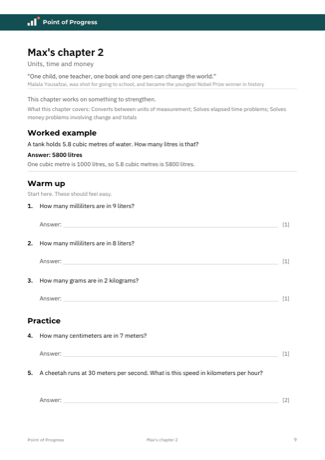
Made for your child and nobody else. Ten chapters built from the questions they actually got wrong, about one a week, so a whole term of practice goes only where it is needed.
The difference
What a school report does not tell you.
A school assessment tells you where your child is, once or twice a year. Point of Progress gives you everything that report gives you, whenever you want it, and then keeps going - down to the individual question, the skill behind it, and what to practice next.
A typical school report
- A score on a stable scale
- A comparison with a typical score for the age
- Growth you can measure by testing again
- A breakdown by broad subject area
- A report at the end of term
Your Point of Progress report
- A score on a stable scale
- A comparison with a typical score for the age
- Growth you can measure by testing again
- A breakdown by broad subject area
- A report the same day your child finishes
- Every question reviewed, with your child’s own answer
- The likely thinking behind a wrong answer, where we can identify it
- Named skills to practice next, not a blended score
- A workbook built from your child’s own results, 10 chapters over 10 weeks
- You choose when to test, and the result is yours
One thing the school has that we do not: their test is sat under supervision, in exam conditions. Ours is taken at your kitchen table, so treat the score as a guide rather than a substitute. If your school uses MAP Growth, CAT4, Star Assessments, i‑Ready or Cambridge Checkpoint, this is the same kind of adaptive test. Point of Progress is independent and is not affiliated with, endorsed by, or connected to any of them.
What you get
A full diagnostic, not just a number.
Adapts to your child
The test gets harder or easier with each answer, so it settles on your child's real level instead of a fixed worksheet.
Item-by-item review
See every question your child answered, the correct answer beside it, and a short explanation of why.
Strengths and development areas
Results are mapped to specific skill areas, so you know where your child is strong and where to focus.
Private and simple
We keep your email and your child's nickname, and delete them after two years. We never ask for their name, date of birth or school.
Your personal report
Your personal report, and the workbook it becomes.
Part of a grade 4 math report. Example figures only.
Grade-level figures are the published norms this kind of assessment uses. We do not publish percentiles, because that needs a norm sample of our own and we have not collected one.
Strengths and development areas
What the test is looking at
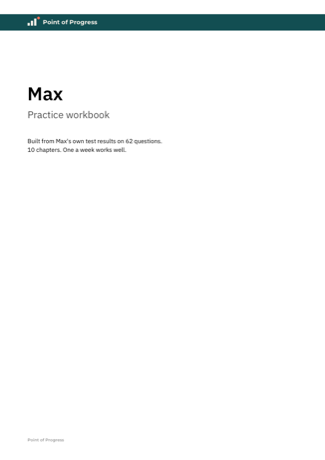
The report becomes an individualised workbook
 Sample workbook
Why it works
Built to mirror the real thing, without the guesswork.
A real adaptive engine
Difficulty adjusts question by question, the same way school assessments narrow in on a level, rather than handing out a fixed set of worksheets.
A faithful rehearsal
The format feels familiar, so your child is comfortable with the pace and question style if they sit the real thing on test day.
Mapped to skills, with next steps
Every result points to concrete areas to practice, so a single score turns into a plan you can follow at home.
Progress you can track
Take the test again later and compare, so you can see growth test over test rather than guessing.
A note on honesty: this is a practice tool. The score is indicative and mirrors the methodology of school-style adaptive assessments. Treat it as a helpful guide for practice, not an official result.
Ready to see where your child stands?
One adaptive test, one clear report.
A single payment, no subscription.