Reading your child's score report
STAAR results explained: what each level actually means for your child
Your child passed the STAAR. That is not the same as being on grade level, and the difference is written into the state’s own definitions. Here is how to read the letter you were sent, and what to do about it.
The four levels, and where the line really falls
Texas reports STAAR in four performance levels. Most parents read the top line, see a pass, and file the letter. The definitions underneath are more specific than the labels suggest, and they are the part worth reading.
| Level | What TEA says it means | Passing? | On grade level? |
|---|---|---|---|
| Did Not Meet Grade Level | Unlikely to succeed in the next grade or course without significant, ongoing academic intervention | No | No |
| Approaches Grade Level | Likely to succeed in the next grade or course with targeted academic intervention | Yes | No |
| Meets Grade Level | High likelihood of success in the next grade or course, but may still need some short-term, targeted academic intervention | Yes | Yes |
| Masters Grade Level | Expected to succeed in the next grade or course with little or no academic intervention | Yes | Yes |
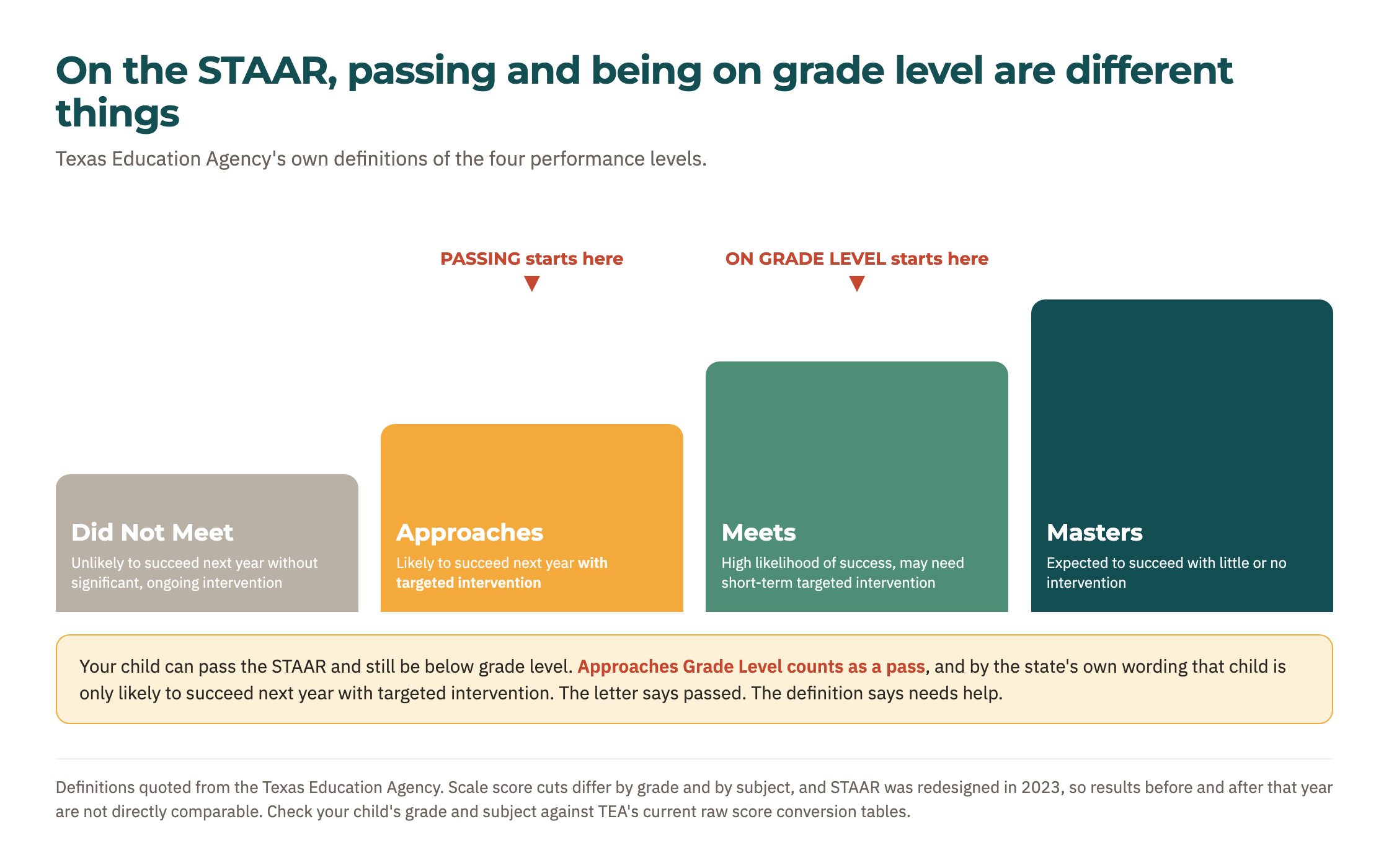
The wording on Approaches is the sentence to sit with. A pass is recorded, and in the same breath the state says the child is likely to succeed next year with targeted academic intervention. That intervention is not automatic. In many districts nothing is triggered by an Approaches result, because the result counts as a pass.
This is not a criticism of your child and it is not a criticism of the school. It is a labelling problem in how results are communicated, and it is well enough known in Texas that a mainstream state policy organisation has published an article whose title is simply the question: does passing the STAAR mean your student is on grade level?
Why the test felt so hard when your child came home
Two different things are often confused here, so it is worth separating them. STAAR itself is a fixed test: every child in a grade and subject sees the same paper. Many of the other assessments your child sits during the year, including the ones schools use for progress monitoring, are computer-adaptive, and those behave very differently.
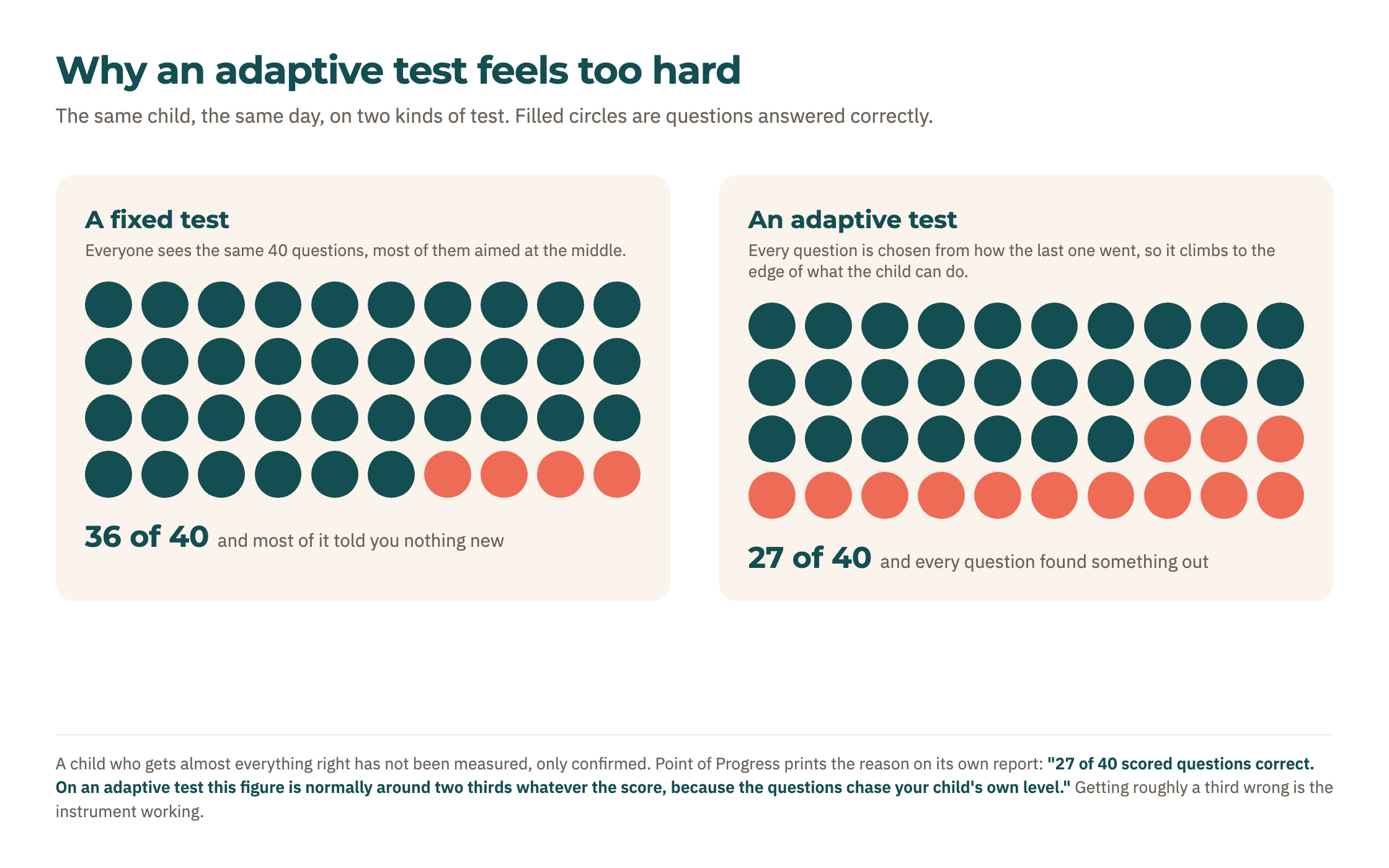
On an adaptive test the questions chase the child. Answer well and the next question is harder; answer badly and it steps back. The test settles at the edge of what the child can do and stays there, which means almost every child finishes having got roughly a third of the questions wrong. A child who found the test uncomfortable has usually been measured properly rather than badly.
What the STAAR report does not tell you
A STAAR report is built for accountability first and for parents second. It answers one question well: did this child clear the state’s bar in this subject this spring. There are three questions it is not designed to answer.
- Which specific skills are weak. Reporting categories are broad. Knowing that a child is below the line in mathematics does not tell you whether the problem is fractions, coordinate geometry or reading the question.
- How certain the result is. A single scale score is reported as a single number. Every test score is really a range, and a child sitting near a cut score could land on either side of it on a different day.
- What to do on Monday morning. The report is a verdict, not a plan. Nothing in it tells you which twenty minutes of practice would help most.
That is not a failure of the test. It is what a once-a-year statewide accountability instrument is for. It does mean that if you want to act on the result, you need something else.
What you can actually do at home
Start with the honest constraint: you cannot buy the STAAR. It is a state assessment. You cannot re-run it, you cannot see the questions your child saw, and no product can give you the same test. Anything claiming otherwise is selling you something it does not have.
What you can do is find out where your child stands independently, in enough detail to act on. These are the realistic options, with what they cost.
| Option | What it gives you | Cost | As of |
|---|---|---|---|
| Khan Academy | Free video lessons and practice across the curriculum. Strong for relearning a concept, weaker at telling you which concept to relearn. | Free | — |
| IXL | Adaptive practice questions by skill, with a parent dashboard broken down by standard. | USD 9.95 per month, or USD 79 per year, for one subject | June 2026 |
| Kumon | In-centre tutoring, typically two 30-minute sessions a week on one subject. | USD 150 to 200 per month per subject, varying by region | August 2026 |
| Point of Progress | An adaptive test in the style of the assessments schools use, a diagnostic report the same day, and a workbook built from the answers your child actually gave. | USD 19.99, paid once, covering both math and reading and writing | September 2026 |
Prices move. Each figure above carries the month it was checked, and the subscription options are per subject, so a household covering both math and reading should double the ones that renew. Over a school year the spread is wide: roughly USD 1,800 to 2,400 for one subject at Kumon, USD 79 for one subject at IXL, nothing at Khan Academy, and a single USD 19.99 payment at Point of Progress. Those are different products solving different problems, and the arithmetic is only one part of choosing between them.
What a diagnostic report should look like
If you are going to spend anything, the thing worth paying for is detail you can act on. This is a page from a Point of Progress report, and it is included here as an illustration of what to look for rather than as a sales pitch. Three features on it matter more than the score at the top.
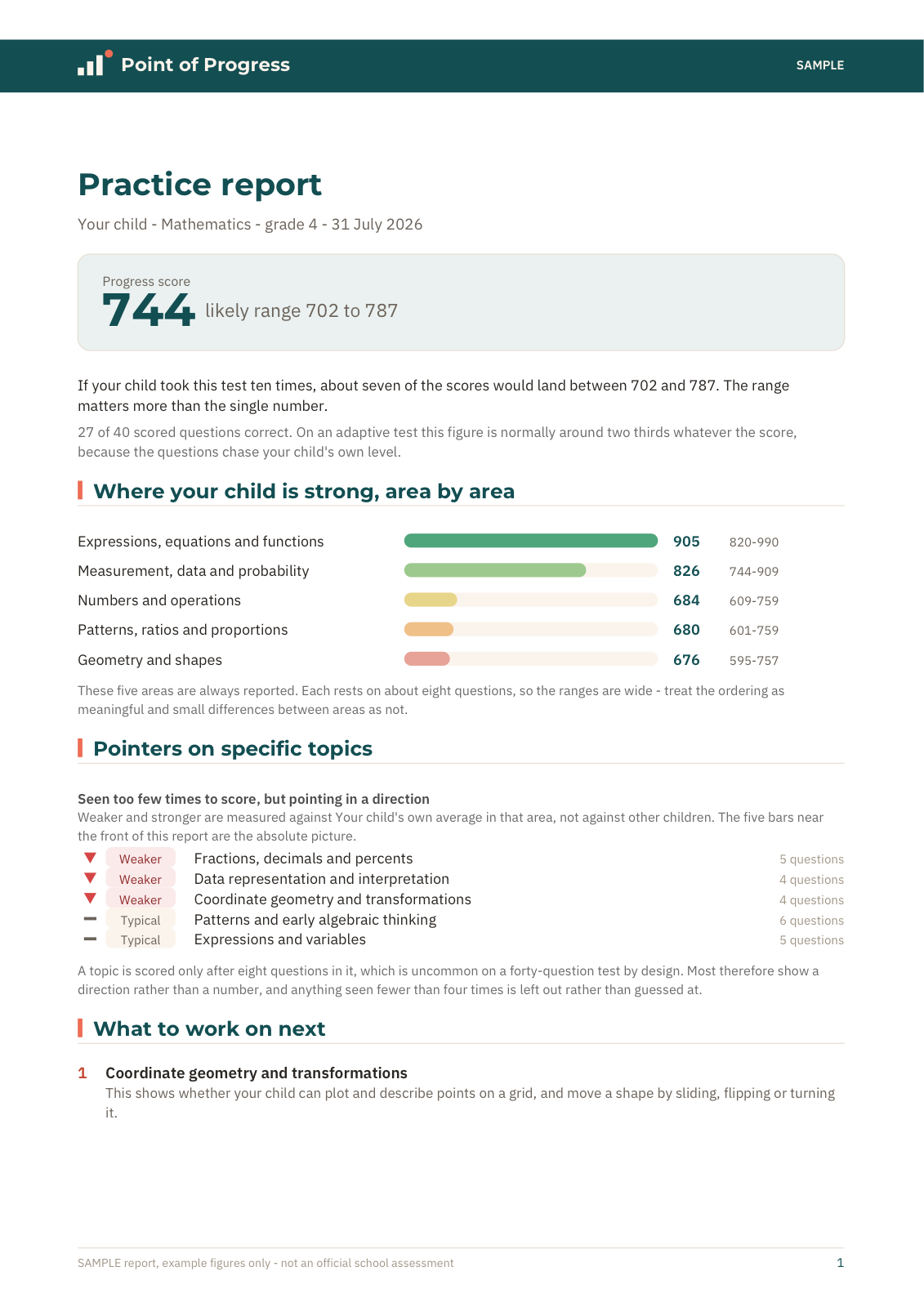
- A range, not just a number. The report gives a likely range alongside the score and explains what it means: if the child took the test ten times, about seven of the results would land inside it. A single number pretending to be precise is doing you a disservice.
- Areas ranked against each other. Five areas, each with its own score and its own range, so you can see the shape of the child’s performance rather than one flat verdict.
- An explanation of the difficulty. The report states outright that around two thirds correct is normal on an adaptive test, which is the single most useful sentence for a parent whose child came home upset.
Turning a result into ten weeks of practice
A diagnosis with no follow-through is just a more detailed worry. The practical question after any assessment is what to do for the next two months.
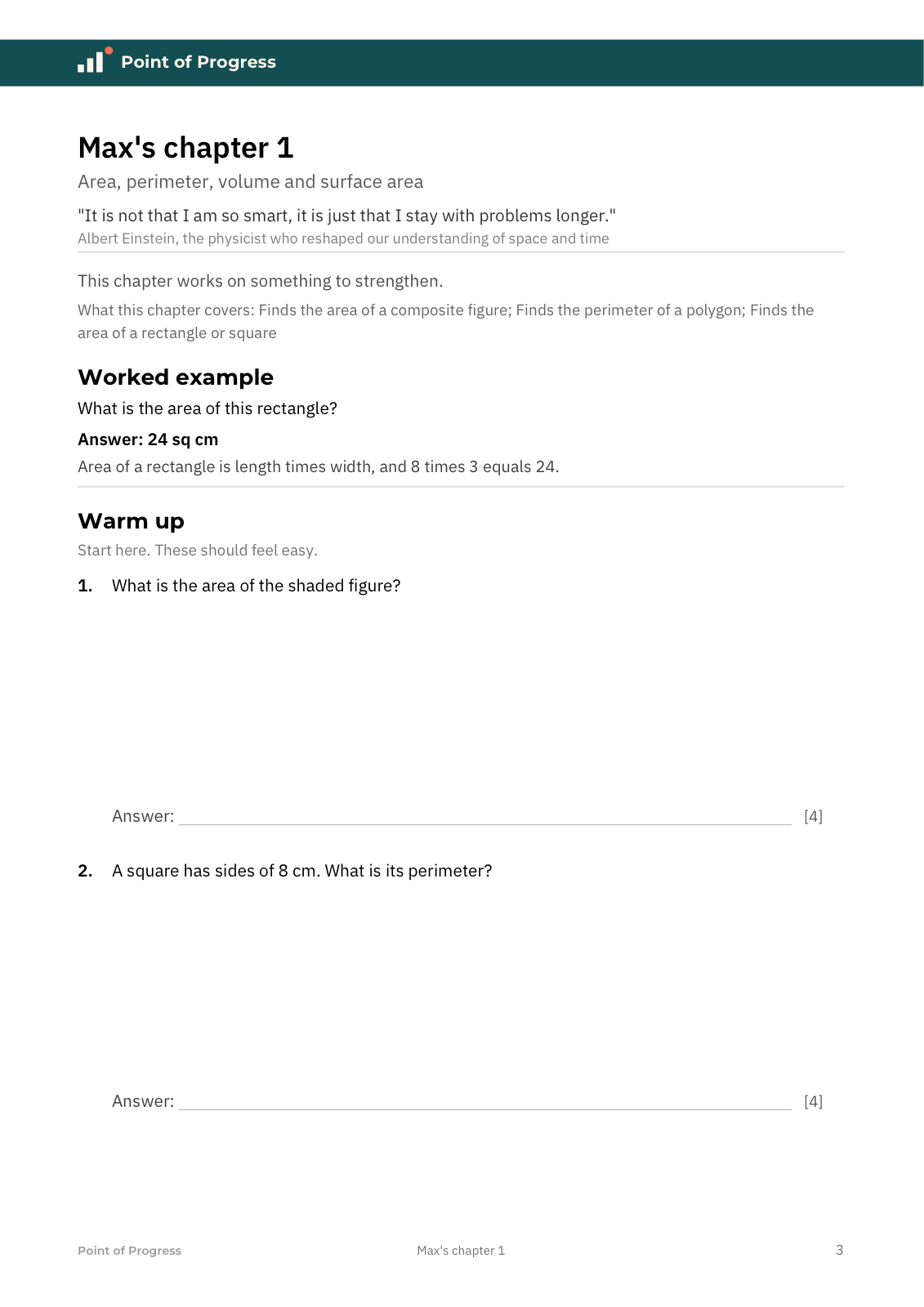
Whatever you use, the test is only worth sitting if something follows it. A report that names three weak topics and then leaves you to find worksheets for them has done half the job.
Is this worth doing for your child?
Probably yes, if
- Your child came back at Approaches and the school has not proposed anything specific.
- The result surprised you, in either direction, and you want a second reading.
- You want to know which topics to work on rather than which subject.
- Your child is in grades 3 to 7, where the gap between passing and being on grade level tends to compound quickly.
Probably not, if
- Your child is already at Masters and enjoying school. Another test will tell you what you already know.
- The school has already put a named intervention in place and you are seeing it work.
- What you actually want is coaching and accountability rather than a diagnosis. That is what tutoring is for, and it costs accordingly.
- You are looking for STAAR questions specifically. Nobody outside TEA has them.
Questions parents ask
Does passing the STAAR mean my child is on grade level?
No. Passing starts at Approaches Grade Level. On grade level starts at Meets. A child at Approaches has passed and is, by the state’s own definition, likely to need targeted academic intervention to succeed next year.
What is a good STAAR score?
There is no single number. Scale score cuts differ by grade and by subject, so a score that clears Meets in one grade will not in another. Look at the performance level rather than the scale score, and check your child’s specific grade and subject against TEA’s current raw score conversion tables.
Can I compare this year’s result with an older one?
Not directly. STAAR was redesigned in 2023 and the standards and scales were re-set between 2022 and 2023. Comparisons across that boundary are not reliable. Grade 5 and grade 8 science moved to updated content as well, which is a further break.
Which grades and subjects sit the STAAR?
Grades 3 to 8 take reading language arts and mathematics. Science is added at grades 5 and 8, and social studies at grade 8. High school students sit end-of-course exams instead.
My child says the test was too hard. Should I be worried?
Usually not, and this is worth explaining to them too. STAAR itself is a fixed test, but much of the testing children now sit is computer-adaptive, and an adaptive test deliberately climbs until the child is getting roughly a third wrong. Finding it hard is the design.
Can I buy a practice STAAR test?
You can buy practice materials from various publishers, but nobody outside the Texas Education Agency has the actual questions. TEA does release some past test materials publicly, which is the closest legitimate source.
Is an at-home test the same as what the school gives?
No, and be suspicious of anything that claims it is. An independent adaptive test can be built in the style of the assessments schools use, and can tell you where a child sits and what to practise, but it is not the school’s instrument and does not produce a school-comparable score.
My child is in grade 9 or 10. Does any of this apply?
Partly. Grades 9 and 10 sit end-of-course exams rather than grades 3 to 8 STAAR, so the level definitions carry over but the subject structure does not.
What to do this week
- Find the letter and look past the pass or fail. Write down the performance level for each subject.
- If any subject came back at Approaches, ask the school one specific question: what targeted intervention is planned, and when will you see it.
- If you want detail the report does not carry, get an independent read at skill level rather than subject level.
- Whatever you choose, make sure something follows the diagnosis. The test is the cheap part.
Sources and dates
Texas Education Agency, STAAR performance level policy definitions, as quoted by Texas 2036, “Does passing the STAAR mean your student is on grade level?”
Texas Education Agency, STAAR Performance Standards, tea.texas.gov
Texas Education Agency, raw score conversion tables by grade and subject, tea.texas.gov
IXL pricing checked June 2026. Kumon pricing range checked August 2026. Point of Progress pricing September 2026.
Where does your child actually stand?
Point of Progress is an independent at-home adaptive test for grades 3 to 10. One purchase covers math and reading & writing, and the report comes the same day: the level, what the child can already do, and the specific skills to practise next. It is not an official assessment and no school accepts the result - it is for you.
See what is included →