Reading your child's score report
i-Ready results explained: why your child was “placed” at a lower grade
i-Ready is the only common school assessment that hands you a grade level instead of a score band. “Grade 2” on a third grader’s report reads like a year lost. It is not that, and the useful information is further down the page.
First, the name changed
From the 2026 to 2027 school year, i-Ready Diagnostic is being renamed i-Ready Inform. The assessment is the same instrument; most guidance written before 2026, including most of what you will find searching for help with your child’s report, still uses the old name. If your school’s letter says one and the portal says the other, that is why.
Two placements from one number
This is where nearly all the confusion starts. i-Ready produces one scale score and then expresses it two ways.
| What it is | How it reads on the report | |
|---|---|---|
| Absolute placement | The grade level that the scale score itself corresponds to, from the placement tables | A grade, for example “Grade 2” |
| Relative placement | That absolute placement compared with your child’s own enrolled grade | A phrase, for example “one grade level below” |
On-grade performance is split into three further steps: Early On Grade Level, Mid Grade Level and Late Grade Level. So a child can be on grade level and still be at the early end of it, which is useful information that a single label would hide.
Curriculum Associates gives this worked example in its own placement tables, and it is the clearest illustration of the whole system.
Student A is in Grade 3 and earned a score of 500 in Reading Overall. In the Grade 3 row, we can see that 500 is in the range from 474-510, which corresponds to a Grade 2 placement. Student A earned an overall placement of Grade 2 in Reading.
Curriculum Associates, i-Ready Diagnostic Scale Score Placement Tables
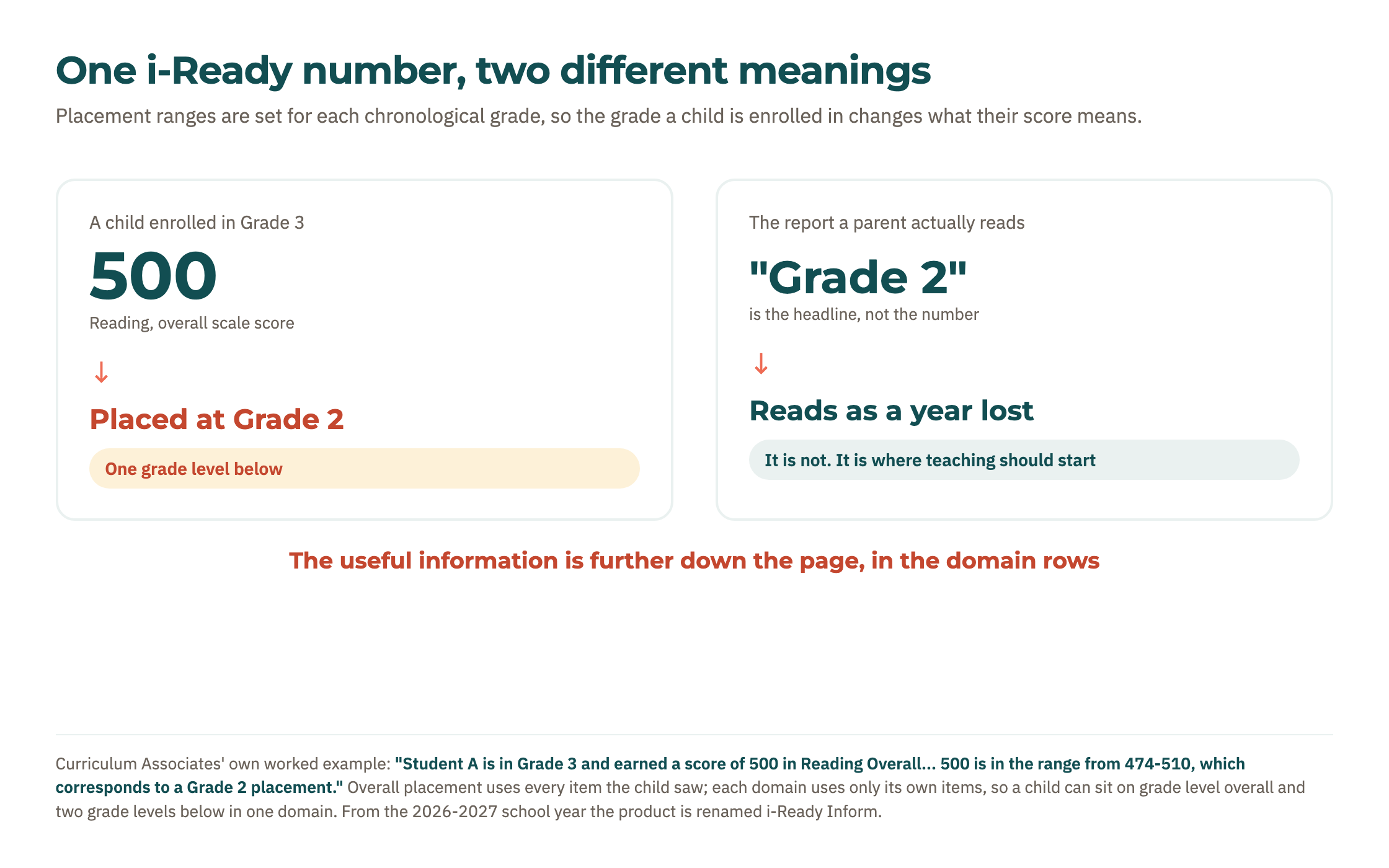
Because the ranges are defined for each chronological grade, the identical scale score produces a different placement for a child in a different year group. The number on its own carries no meaning until you know which grade the child is enrolled in.
Why we are not printing the full score tables
Most articles on this subject publish a wall of scale score ranges. We are deliberately not doing that. Curriculum Associates updates the placement tables, they are versioned by school year, and a stale cut score is worse than no cut score because it looks authoritative while being wrong. Ask your child’s school which year’s tables they are using, or find the current set on the district’s own site. The mechanism above is what you actually need in order to read the report; the exact boundaries change.
The part of the report worth reading
The headline placement is the least useful thing on an i-Ready report, and it is the thing that stops parents reading further.
The overall score is computed from every item the child saw. Each domain score is computed only from the items in that domain. Because of that, overall and domain placements can disagree sharply: a child can sit on grade level overall and two grade levels below in one domain, or the reverse. The domain rows are where anything actionable lives.
- Read the domains before the headline. A single weak domain dragging down an otherwise solid profile is a completely different problem from an even profile sitting slightly low, and the two need different responses.
- Treat one domain as one signal. Domain scores rest on fewer questions than the overall score, so they are less precise. Look at the ordering rather than small differences between adjacent domains.
- Placements are criterion referenced. They describe what students are expected to know at each grade in each content area, set through a standard-setting process Curriculum Associates says involved more than 100 teachers. They are not a ranking against other children.
Why your child said it was too hard
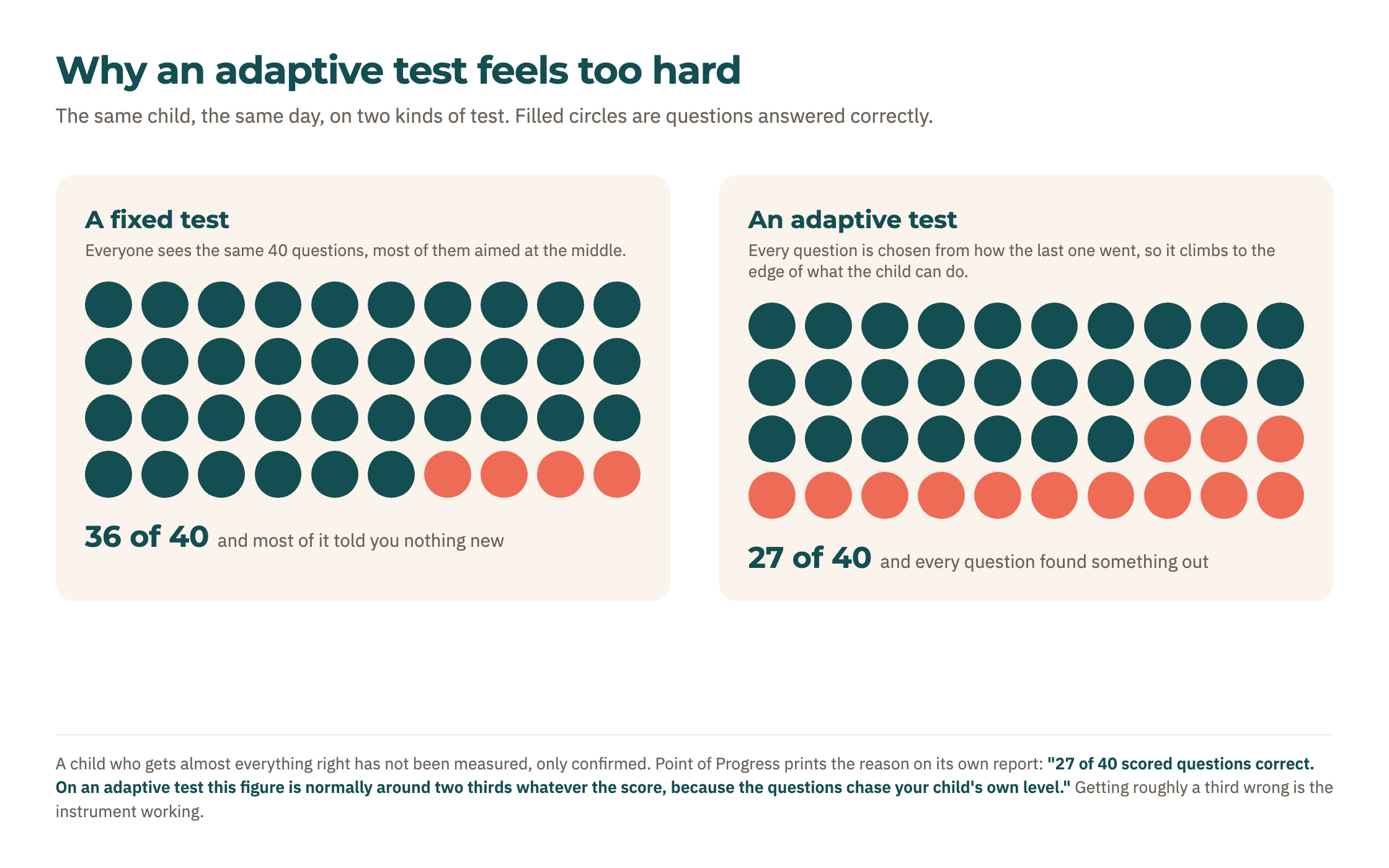
i-Ready is computer-adaptive, with defined test flows and stopping rules. The questions climb while the child is answering well and step back when they are not, settling at the edge of what the child can do.
So a child finishing an adaptive test having got roughly a third of the questions wrong has had a normal experience, not a bad one. That is true at every ability level. It is worth telling the child as well as knowing it yourself.
What the report does not give you
- A reason. A placement tells you where a child sits, not why. A grade-below placement in reading could be decoding, vocabulary, stamina or comprehension, and those need different work.
- A range. Placements are reported as categories, which hides how close a child was to the boundary. A child one point below a cut and a child forty points below it get the same label.
- A plan. Schools use i-Ready to route instruction, and that routing happens at school. It does not arrive at your kitchen table as a set of things to do.
What you can do at home
i-Ready is licensed to schools, not sold to families. You cannot re-run your child’s Diagnostic and you cannot see the items they saw. What follows are the realistic independent options.
| Option | What it gives you | Cost | As of |
|---|---|---|---|
| Khan Academy | Free lessons and practice across the curriculum, strongest once you already know what to work on. | Free | — |
| IXL | Adaptive practice by skill with a parent dashboard broken down by standard. | USD 9.95 per month, or USD 79 per year, for one subject | June 2026 |
| Kumon | In-centre tutoring, typically two 30-minute sessions a week on one subject. | USD 150 to 200 per month per subject, varying by region | August 2026 |
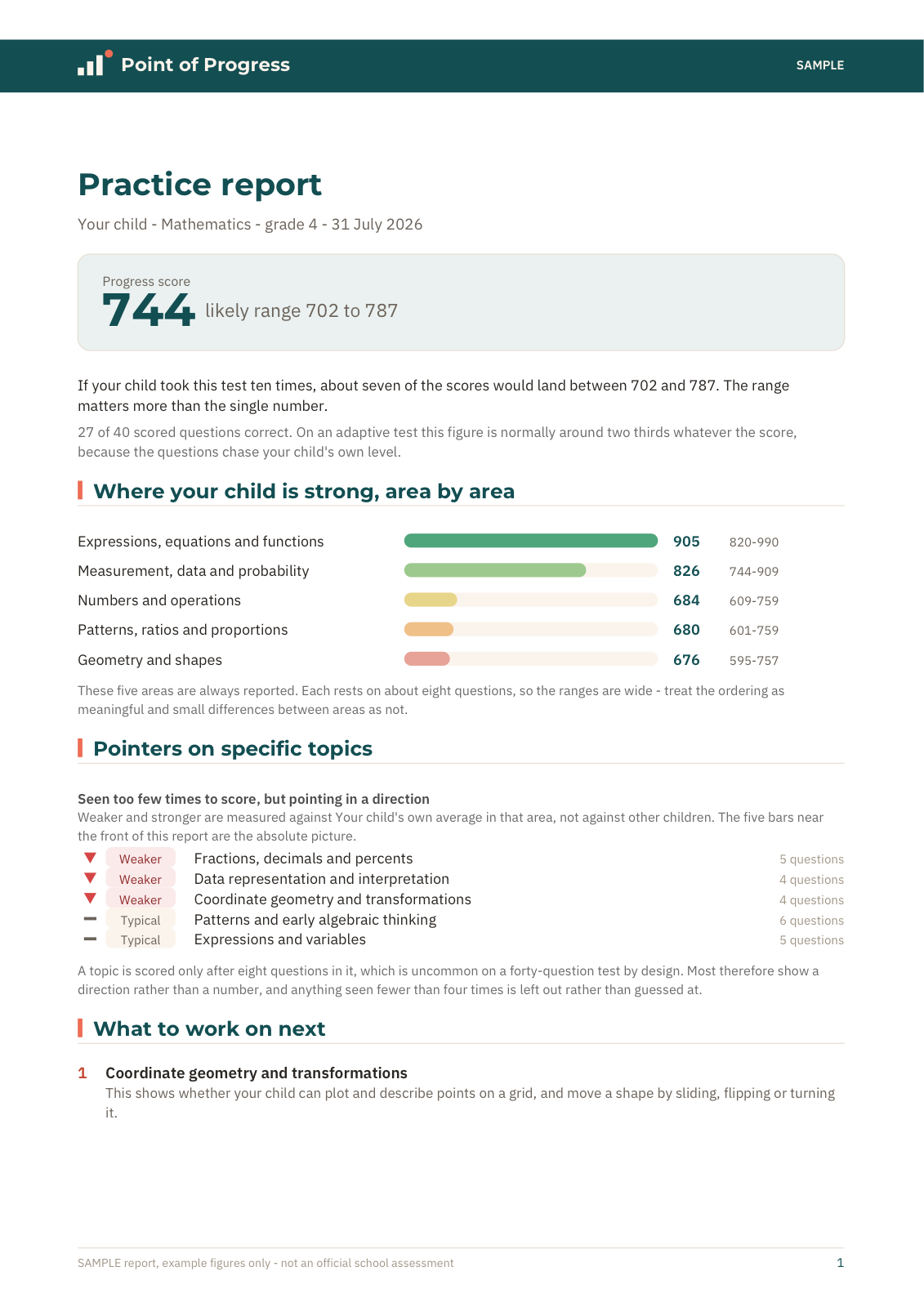
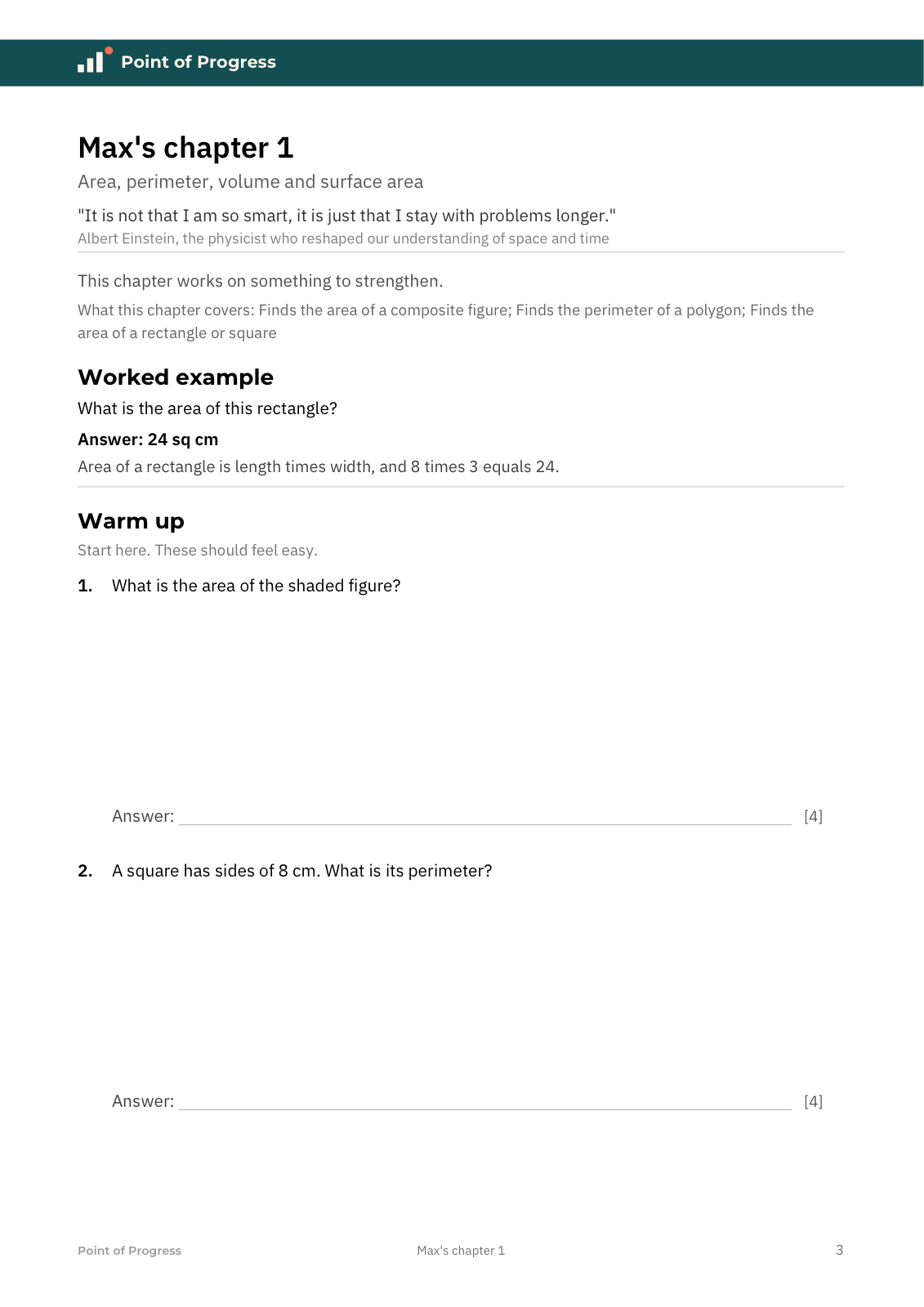
| Point of Progress | An adaptive test in the style of the assessments schools use, a report the same day at skill level, and a workbook built from your child’s own answers. | USD 19.99 once, covering both math and reading and writing | September 2026 |
The distinction that matters for an i-Ready result specifically is between a product that gives you another label and a product that gives you a list of topics. If the school has already told you the child is one grade level below in reading, a second source telling you the same thing in different words has added nothing.
Is this worth doing?
Probably yes, if
- The placement said one or two grade levels below and you do not know which specific skills are behind it.
- The overall placement and the domain placements disagree and you cannot tell which to believe.
- You want something to work on rather than something to worry about.
- Your child is in grades 3 to 7.
Probably not, if
- Your child placed at Mid or Late Grade Level across every domain.
- The school has already named the gap and started specific work on it.
- You want weekly accountability rather than a diagnosis.
Questions parents ask
My third grader was placed at Grade 2. Are they a year behind?
Not in the sense the phrase suggests. The placement says which grade level of content the score corresponds to, so instruction can start in the right place. It is not a statement that a year of school was lost, and it is not a retention decision.
Why is the overall placement different from the domain placements?
Because they are computed from different items. The overall score uses everything the child saw; each domain uses only its own items. A single weak domain can sit well below an otherwise solid overall placement.
What is a good i-Ready score?
There is no single good score, because the ranges are set per enrolled grade. The same scale score is on grade level for a younger child and below it for an older one. Read the placement, not the number.
Has i-Ready changed its name?
Yes. From the 2026 to 2027 school year, i-Ready Diagnostic is called i-Ready Inform. Most material online still uses the older name.
How often will my child take it?
Schools typically administer it two or three times a year, which is what makes the growth comparison possible.
Can I get the scale score tables?
Curriculum Associates publishes them and districts often host a copy. Check the school year on whichever version you find, because they are updated and an out-of-date table will give you the wrong answer with total confidence.
My child found it very hard. Does that mean the placement is wrong?
Usually the opposite. An adaptive test is meant to climb until the child is getting roughly a third wrong. A test that felt easy is more likely to have measured badly than one that felt hard.
Can I buy i-Ready to use at home?
No. Curriculum Associates licenses it to schools and districts. Products marketed to families as i-Ready practice are third-party materials, not the assessment.
What to do this week
- Ignore the headline placement for a moment and read the domain rows.
- Write down the one or two domains furthest below the rest. That is your list, not the grade level.
- Ask the school what the placement changed about your child’s instruction, since routing instruction is what the assessment is for.
- If you want topic-level detail the report does not carry, get it from something designed to produce it.
Sources and dates
Curriculum Associates, i-Ready Diagnostic Grades K-12 Scale Score Placement Tables, and the accompanying guidance on absolute and relative placements.
Curriculum Associates, i-Ready Inform, formerly i-Ready Diagnostic: resources on diagnostic scores and placements, curriculumassociates.com. Rename effective school year 2026-2027.
IXL pricing checked June 2026. Kumon pricing range checked August 2026. Point of Progress pricing September 2026.
i-Ready and i-Ready Inform are trademarks of Curriculum Associates. This article is independent and is not affiliated with or endorsed by Curriculum Associates.
Where does your child actually stand?
Point of Progress is an independent at-home adaptive test for grades 3 to 10. One purchase covers math and reading & writing, and the report comes the same day: the level, what the child can already do, and the specific skills to practise next. It is not an official assessment and no school accepts the result - it is for you.
See what is included →