Reading your child's score report
Florida FAST scores explained: why the autumn result looks so bad
Your child sat the FAST in September and came back below grade level. Florida’s own guidance says that is the expected result and not an achievement designation. Here is why, and what the three testing windows actually mean.
The calendar, not the child
FAST is administered three times a year: PM1 at the start, PM2 in the middle, PM3 at the end. It is tempting to read those as three attempts at the same bar. They are not. Each administration covers the full test blueprint, meaning all the content expectations for that subject and grade for the whole year.
A child sitting PM1 in September is therefore being asked about things scheduled to be taught in February. Florida says what follows from that in plain terms.
for PM1 and PM2, a student is likely to not score at grade level; however, that does not necessarily indicate that the student is not on track to succeed... PM1 and PM2 results are for informational purposes only and should be used to identify areas in which students may need additional instruction and support. These results should not be considered student achievement designations.
Florida Department of Education, Understanding Florida Statewide Assessments Reports for Families, April 2026
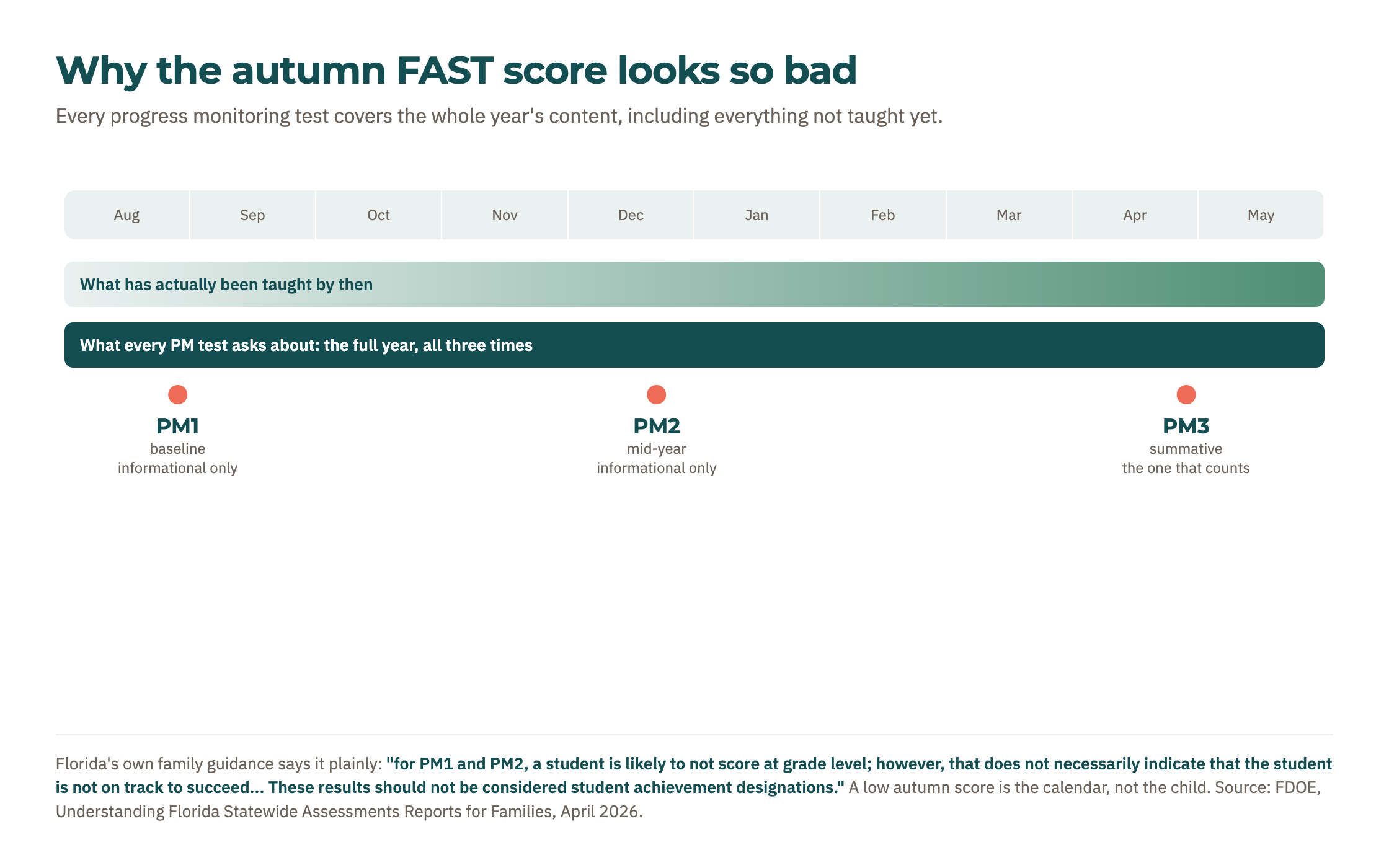
If the autumn report frightened you, that is the thing to hold onto. It is not a verdict, it is a baseline, and the state says so in its own family guidance.
The five levels, and a labelling trap
FAST reports Achievement Levels 1 to 5. Level 3 indicates on grade level performance across all assessments.
| Level | Label | What FDOE says it means |
|---|---|---|
| 1 | Well Below Grade Level | Highly likely to need substantial support for the next grade or course |
| 2 | Below Grade Level | Likely to need substantial support for the next grade or course |
| 3 | On Grade Level | May need additional support for the next grade or course |
| 4 | Proficient | Likely to excel in the next grade or course |
| 5 | Exemplary | Highly likely to excel in the next grade or course |
One further wrinkle: Science and Social Studies use the same 1 to 5 scale with different names, Inadequate, Below Satisfactory, On Grade Level, Proficient and Mastery. Do not read them as the FAST labels.
The scale score ranges
These are the ranges published in Florida’s April 2026 family guidance. Check the current version each school year, because they are revised.
FAST ELA Reading
| Grade | Level 1 | Level 2 | Level 3 | Level 4 | Level 5 |
|---|---|---|---|---|---|
| 3 | 140-185 | 186-200 | 201-212 | 213-224 | 225-260 |
| 4 | 154-198 | 199-212 | 213-223 | 224-236 | 237-270 |
| 5 | 160-205 | 206-221 | 222-231 | 232-245 | 246-279 |
| 6 | 161-208 | 209-224 | 225-236 | 237-249 | 250-284 |
| 7 | 165-214 | 215-231 | 232-241 | 242-256 | 257-292 |
| 8 | 169-219 | 220-237 | 238-250 | 251-261 | 262-300 |
| 9 | 174-223 | 224-241 | 242-253 | 254-266 | 267-303 |
| 10 | 179-229 | 230-246 | 247-257 | 258-270 | 271-308 |
FAST Mathematics
| Grade | Level 1 | Level 2 | Level 3 | Level 4 | Level 5 |
|---|---|---|---|---|---|
| 3 | 140-182 | 183-197 | 198-208 | 209-224 | 225-260 |
| 4 | 155-199 | 200-210 | 211-220 | 221-237 | 238-273 |
| 5 | 158-206 | 207-221 | 222-233 | 234-245 | 246-285 |
| 6 | 168-212 | 213-228 | 229-238 | 239-253 | 254-287 |
| 7 | 175-222 | 223-234 | 235-246 | 247-257 | 258-288 |
| 8 | 183-226 | 227-243 | 244-253 | 254-262 | 263-291 |
FAST ELA Reading runs from grade 3 to grade 10. FAST Mathematics runs from grade 3 to grade 8, after which students move to end-of-course assessments in Algebra 1 and Geometry.
FAST is adaptive, and that is why it felt hard
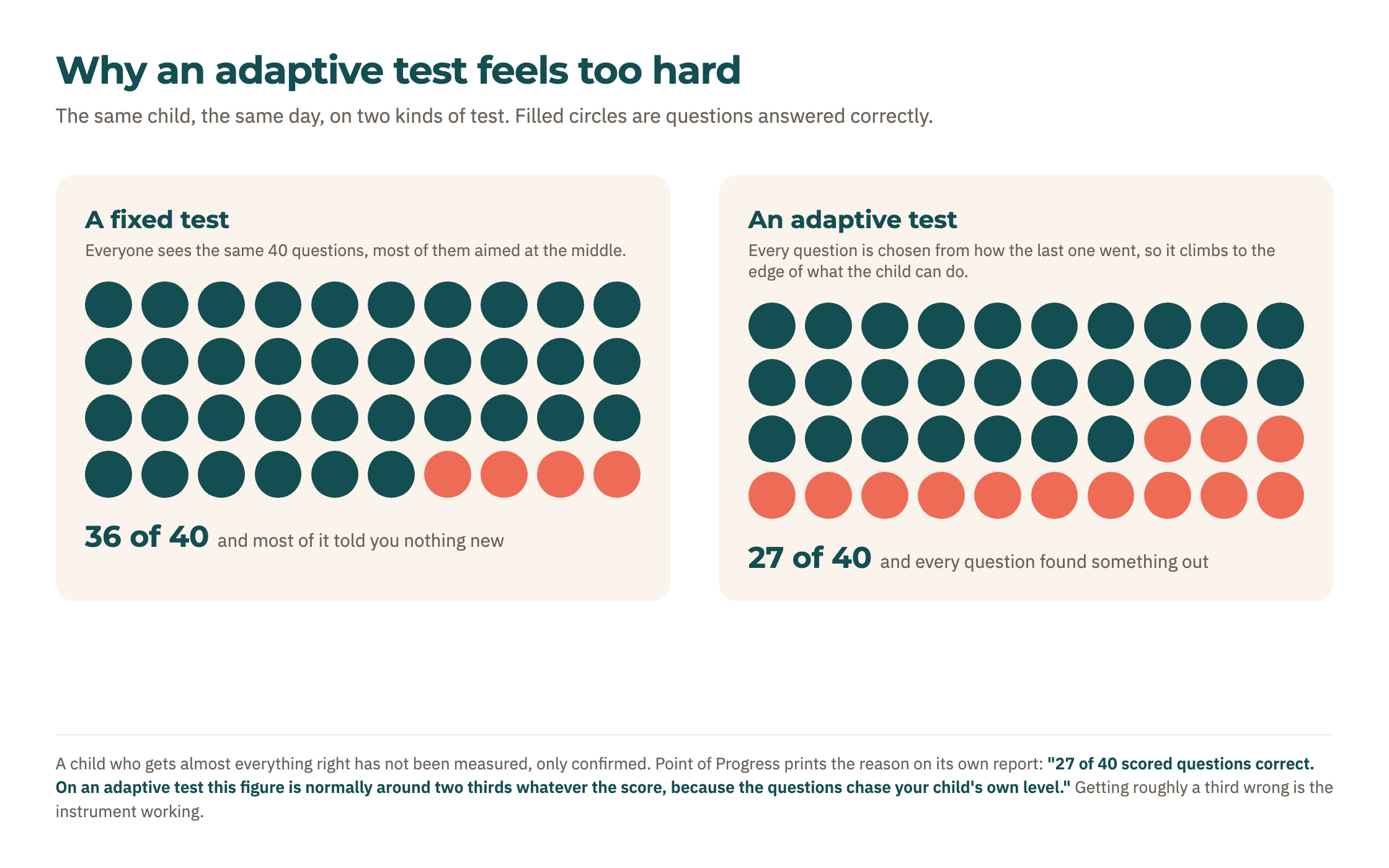
The FAST grades 3 to 10 ELA Reading and grades 3 to 8 Mathematics assessments are computer-adaptive. So are the grade 5 and 8 Science tests and the end-of-course exams. The questions chase the child: harder after a correct answer, easier after a wrong one, converging on the edge of what they can do.
The result is that almost every child, at every level of ability, finishes having got roughly a third of the questions wrong. Combine that with a PM1 that asks about content taught in February, and an autumn test can feel genuinely awful while being entirely normal.
One useful detail specific to FAST: percentile ranks are reported at every PM window for grades 3 to 10, and they are based on the previous school year’s percentile ranks. So the comparison group is last year’s children, not this year’s.
What the report does not tell you
- Whether a low PM1 matters. The report gives a level. It does not tell you whether this particular child at this particular point is behind or simply early, and the state’s own caution about PM1 and PM2 is buried in a guidance document rather than printed on the result.
- Which skills to work on. Achievement levels by reporting category are broader than a topic. They narrow the search; they do not end it.
- What to do between windows. There are months between PM1 and PM2, and nothing in the report says how to use them.
What you can do at home
FAST is a state assessment. You cannot buy it, re-run it or see the items. What you can do is get an independent reading in enough detail to act on.
| Option | What it gives you | Cost | As of |
|---|---|---|---|
| Khan Academy | Free lessons and practice across the curriculum, strongest once you know the topic to attack. | Free | — |
| IXL | Adaptive practice by skill with a parent dashboard broken down by standard. | USD 9.95 per month, or USD 79 per year, for one subject | June 2026 |
| Kumon | In-centre tutoring, typically two 30-minute sessions a week on one subject. | USD 150 to 200 per month per subject, varying by region | August 2026 |
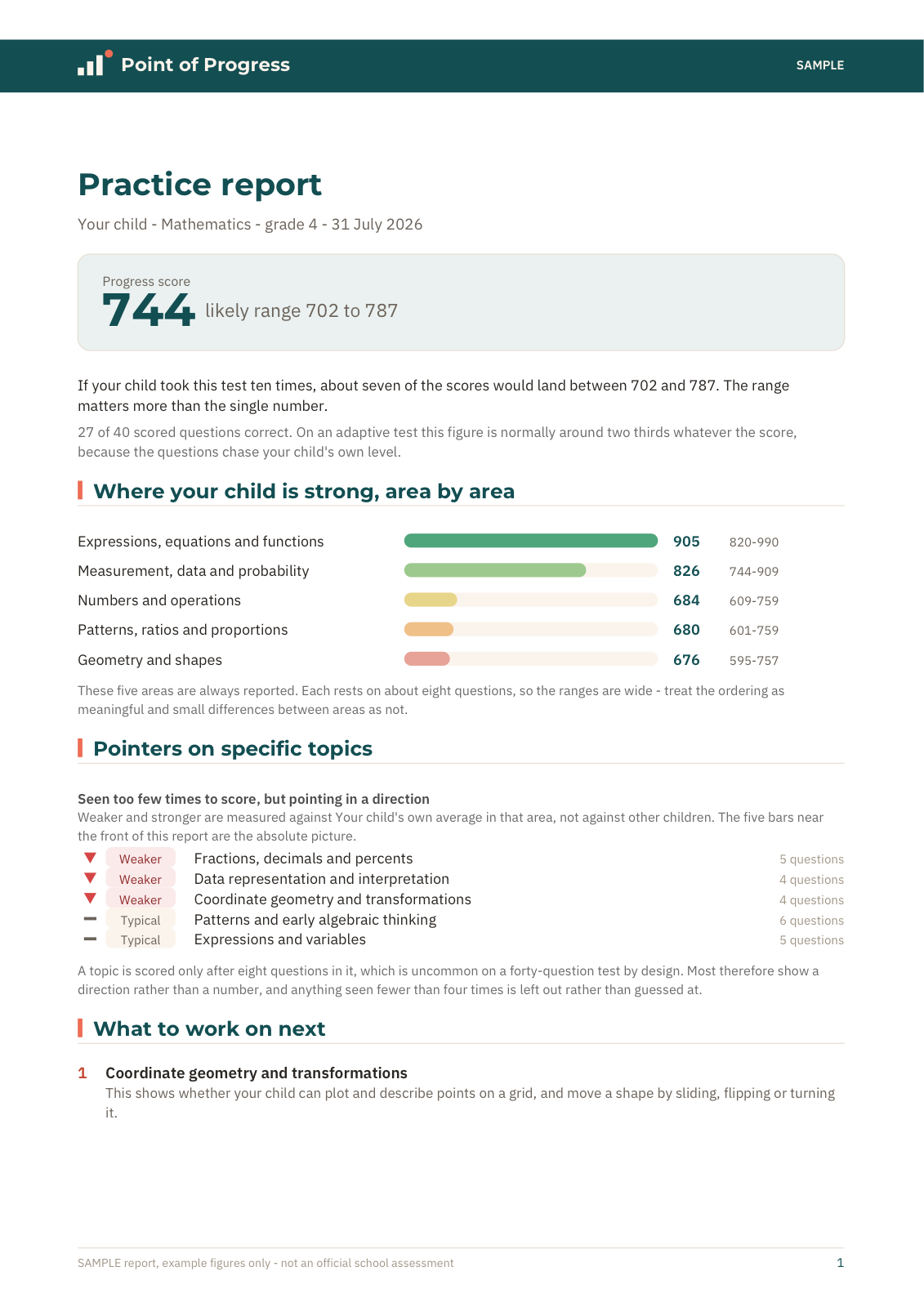
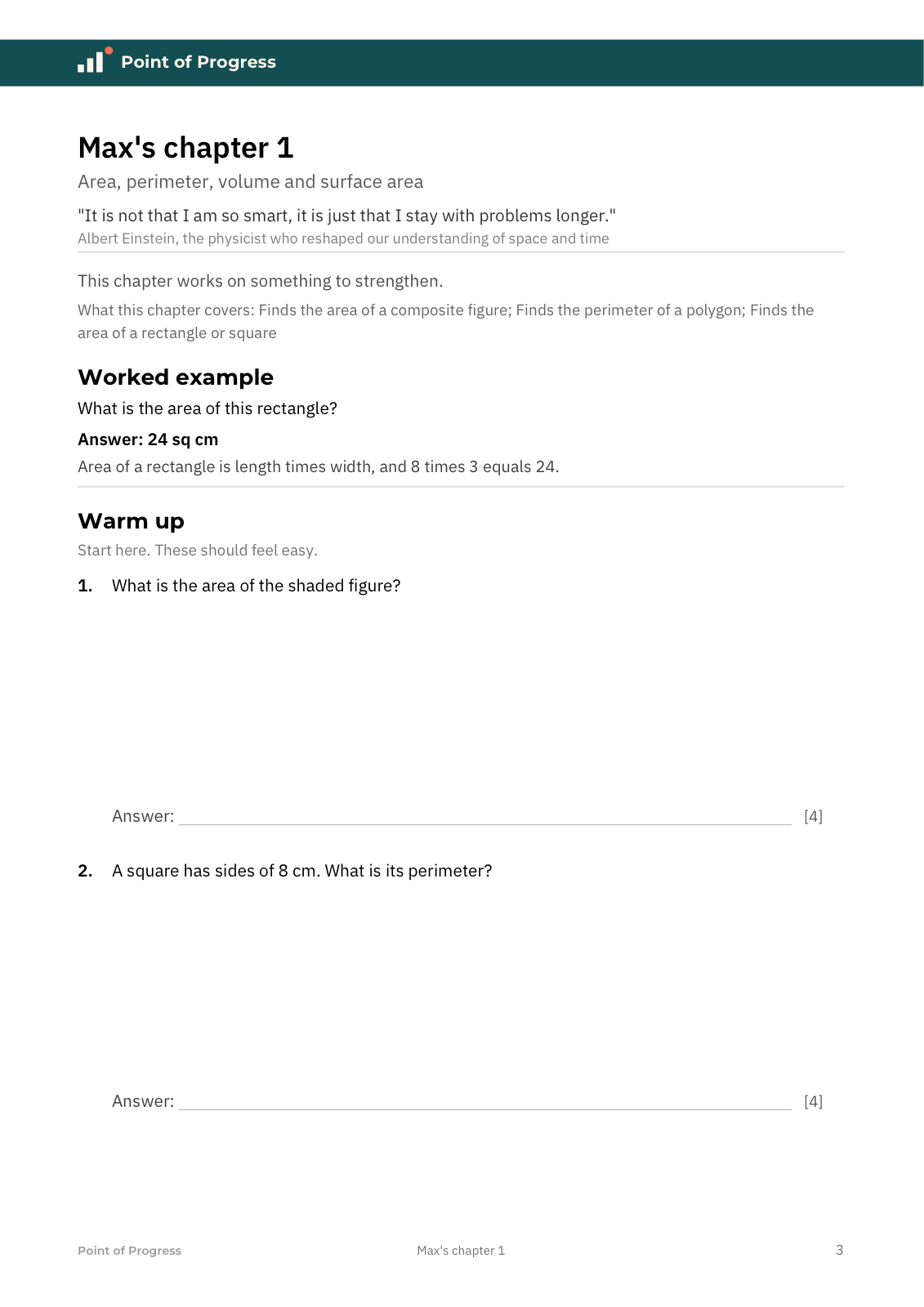
| Point of Progress | An adaptive test in the style of the assessments schools use, a report the same day, and a workbook built from your child’s own answers. | USD 19.99 once, covering both math and reading and writing | September 2026 |
The window between PM1 and PM2 is the natural place to use any of these, because it is long enough for practice to show up and early enough to matter. That is a scheduling point rather than a sales point: whatever you choose, choosing it in October is worth more than choosing it in April.
Is this worth doing?
Probably yes, if
- PM1 came back at Level 1 or 2 and you want to know whether it is the calendar or a real gap.
- The level did not move between PM1 and PM2.
- You want named topics rather than a number.
- Your child is in grades 3 to 7.
Probably not, if
- Your child is at Level 4 or 5 and content at school.
- It is PM1, the result was mildly low, and nothing else has given you cause for concern. Waiting for PM2 is a legitimate choice.
- You want weekly structure and someone else to enforce it.
Questions parents ask
My child scored below grade level on PM1. Should I panic?
No. Every PM test covers the full year, so PM1 asks about content not yet taught. Florida states that PM1 and PM2 results are informational and should not be treated as achievement designations. Look at the trend across the three windows rather than the first one alone.
Which window actually counts?
PM3. It provides the summative score measuring mastery of the grade-level standards at the end of the year, and the PM3 report shows all three windows together for comparison.
Is Level 3 good?
Level 3 is on grade level. In Florida, Proficient is Level 4, so on grade level sits below proficient. Both facts are true and the labels invite confusion.
What grades take FAST?
ELA Reading covers grades 3 to 10. Mathematics covers grades 3 to 8. Beyond that, students take end-of-course assessments such as Algebra 1 and Geometry.
Is FAST computer-adaptive?
Yes. FAST ELA Reading grades 3 to 10, FAST Mathematics grades 3 to 8, grades 5 and 8 Science and all end-of-course assessments are computer-adaptive. FCLE is a fixed-form test.
What is the percentile on the report comparing my child to?
Percentile ranks are reported for FAST grades 3 to 10 at each PM window, and they are based on the previous school year’s percentile ranks rather than the current cohort.
Where do I find the results?
In Florida’s Family Portal, using the access code your child’s school provides along with their date of birth and first name. Access codes are reset annually in October.
My child says the test was too hard. Is something wrong?
Almost certainly not. FAST is adaptive, so it climbs until your child is getting roughly a third wrong, and at PM1 it is also asking about material not yet covered. Both effects push in the same direction.
What to do this week
- Check which window the report is from. If it says PM1 or PM2, read it as a baseline.
- Note the level and the reporting categories, then compare with the next window rather than with the bar.
- Use the gap between PM1 and PM2. It is the longest stretch of the year in which practice can still change the PM3 result.
- If you want topic-level detail, get it from something built to produce it.
Sources and dates
Florida Department of Education, Understanding Florida Statewide Assessments Reports for Families, April 2026, flfast.org. Achievement level definitions and scale score ranges taken from that document.
Florida Department of Education, FAST assessments overview, fldoe.org
IXL pricing checked June 2026. Kumon pricing range checked August 2026. Point of Progress pricing September 2026.
FAST and B.E.S.T. are programmes of the Florida Department of Education. This article is independent and is not affiliated with or endorsed by FDOE.
Where does your child actually stand?
Point of Progress is an independent at-home adaptive test for grades 3 to 10. One purchase covers math and reading & writing, and the report comes the same day: the level, what the child can already do, and the specific skills to practise next. It is not an official assessment and no school accepts the result - it is for you.
See what is included →